
These 20 essential Mandarin phrases cover greetings, introductions, politeness, and the questions you need when you get stuck. Each one is written in pinyin with tone marks, followed by its English meaning. To really use them, you need to say them out loud with the right tones, which is exactly what we practice in our Conversational Mandarin Chinese, Level 1 class.
The 20 phrases
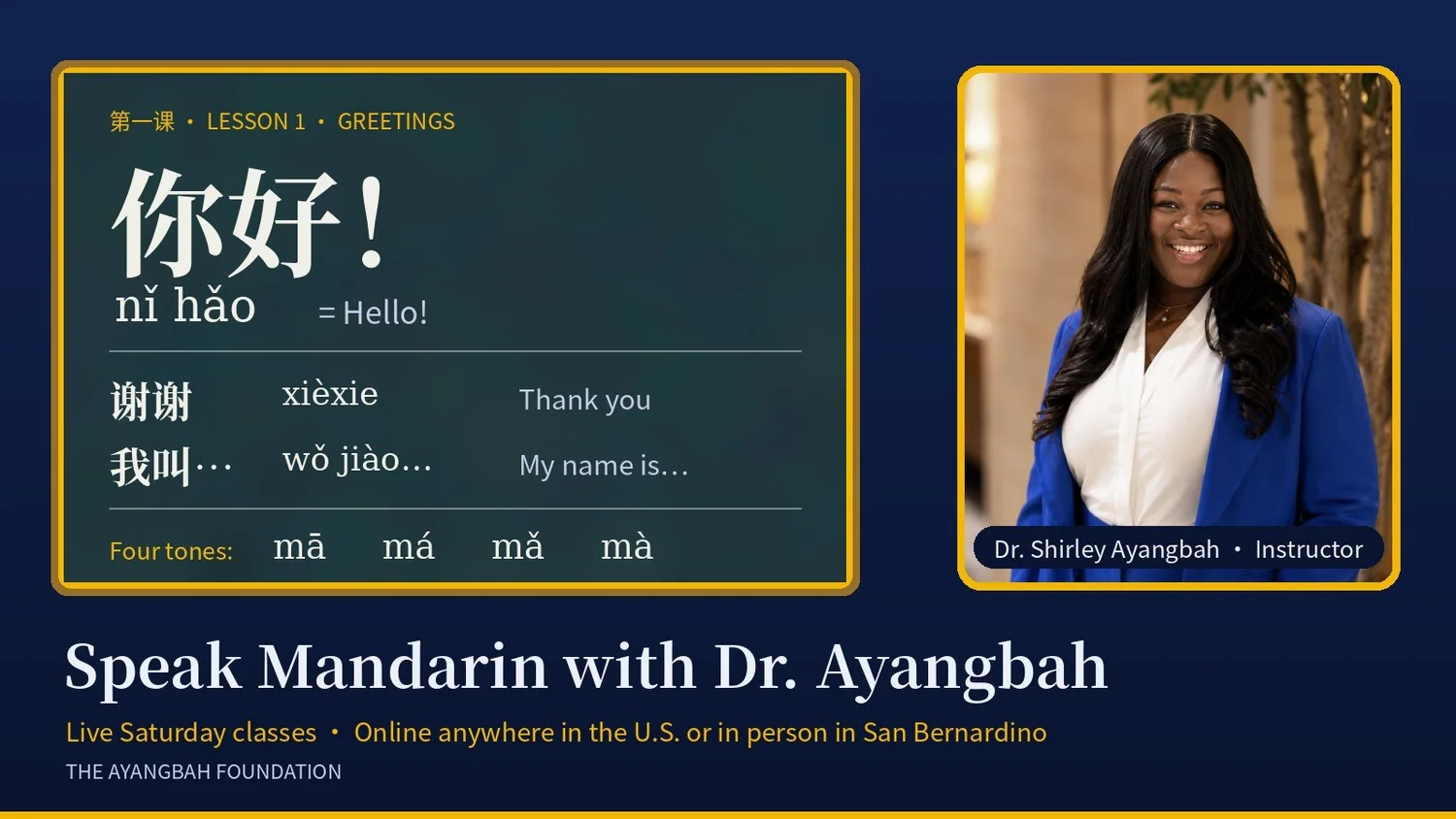
- Nǐ hǎo: Hello
- Nín hǎo: Hello (polite, for elders, clients or people you just met)
- Nǐ hǎo ma?: How are you?
- Wǒ hěn hǎo: I'm fine / I'm doing well
- Xièxie: Thank you
- Bú kèqi: You're welcome
- Duìbuqǐ: I'm sorry
- Méi guānxi: It's okay / No problem
- Zàijiàn: Goodbye
- Nǐ jiào shénme míngzi?: What's your name?
- Wǒ jiào...: My name is...
- Hěn gāoxìng rènshi nǐ: Nice to meet you
- Wǒ shì Měiguó rén: I'm American
- Qǐngwèn: Excuse me, may I ask...
- Wǒ bù dǒng: I don't understand
- Qǐng zài shuō yí biàn: Please say that again
- Qǐng shuō màn yìdiǎn: Please speak a little more slowly
- Duōshao qián?: How much is it?
- ...zài nǎr?: Where is...?
- Shì / Bú shì: Yes, it is / No, it isn't
How to use these phrases in real life
Notice how the list groups together. Phrases 1 to 9 get you through almost any polite encounter. Phrases 10 to 13 handle introductions. Phrases 14 to 17 are your safety net when you do not understand. Phrases 18 to 20 help with shopping, directions and simple answers.
Try putting a few together:
- Nǐ hǎo! Wǒ jiào Maria. Hěn gāoxìng rènshi nǐ.: Hello! My name is Maria. Nice to meet you.
- Qǐngwèn, xǐshǒujiān zài nǎr?: Excuse me, where is the restroom?
- Duìbuqǐ, wǒ bù dǒng. Qǐng zài shuō yí biàn.: Sorry, I don't understand. Please say that again.
Pronunciation tips
- Watch the tone marks. The marks over vowels show the tone. They are part of the word, not decoration.
- Nǐ hǎo is written with two third tones, but the first one is said as a rising tone, so it sounds like "ní hǎo."
- Bù (not) changes to bú before a fourth tone, which is why you see bú kèqi and bú shì.
- Xièxie ends with a light neutral tone. Do not stress the second syllable.
- The "x" in xièxie is not like the English "x." It is a soft sound, closer to "sh" with your tongue behind your lower teeth.
How to practice so they stick
- Pick five phrases a day and say each one out loud ten times.
- Use them in small moments: greet your family, thank a coworker, say goodbye to your dog.
- Record yourself and listen back.
- Practice with a partner, taking turns asking and answering.
- Get feedback on your tones from a live teacher.
In our class, phrases like these are practiced through role-play every session: greetings, introductions, numbers, time, shopping and directions. You will leave each Saturday with phrases you have actually said in conversation, not just read.
Class details
- Class: Conversational Mandarin Chinese, Level 1, taught in English by The Ayangbah Foundation
- Dates: Saturdays, October 17 to December 12, 2026 (no class November 28). 8 weeks, 16 hours total.
- Live online: 9:00-11:00 AM Pacific (12:00-2:00 PM Eastern), from anywhere in the U.S.
- In person: 11:30 AM-1:30 PM at 255 N. D Street, Suite #200-XXVII, San Bernardino, CA 92401
- Tuition: $297
- What you get: speaking-first lessons covering pinyin, the four tones, greetings, numbers, time, shopping and directions, with role-play in every class. The textbook is Developing Chinese: Elementary Comprehensive Course 1 (2nd Edition), which you buy separately.
Required textbook

Speak Mandarin with Dr. Ayangbah uses Developing Chinese: Elementary Comprehensive Course 1 (2nd Edition, with MP3 audio), 发展汉语 初级综合 (I), by Rong Jihua (Beijing Language and Culture University Press). Get the 2nd Edition of Elementary Comprehensive Course 1 and have it by the first class. Buy it on Amazon.
How to enroll
- Apply online. It takes about 2 minutes.
- Pay $297 through the Mandarin class pay link or on our tuition page.
- We confirm your seat within 2 business days.
Want to ask questions first? Join our free info session and orientation, online every Monday from 5:00 to 5:45 PM Pacific. Register on the enroll page to get the link.
FAQ
What is the most important Mandarin phrase for beginners?
Nǐ hǎo (hello) is the classic first phrase, but Qǐngwèn (excuse me, may I ask) and Wǒ bù dǒng (I don't understand) are just as useful in real conversations.
What do the marks over the pinyin letters mean?
They show the tone. Mandarin has four main tones plus a neutral tone, and the tone is part of the word's meaning.
Is learning phrases enough to have a conversation?
Phrases are a great start. To hold a conversation, you also need listening practice and real speaking time, which is what weekly role-play in class gives you.
Questions? Call or text (909) 454-7076, or email info@ayangbahfoundation.org.